Education & Human Development
Project MANAV 2035: When Artificial Intelligence Becomes Smarter, What Happens to Humanity?
The future needs more than AI. It needs Biological Intelligence, human wisdom and a new purpose for education.
The question we are not asking
Imagine the world in 2035. A child learns with an AI tutor who can patiently explain a difficult idea a hundred different ways. A physician reviews evidence with intelligent digital support. A farmer receives timely crop and weather information. A business uses AI to reduce repetitive work. A public institution can analyze complex problems more quickly.
Everything around us is becoming more intelligent. But are we becoming healthier, wiser, more compassionate and better prepared to live?
We are investing enormous resources in developing Artificial Intelligence. Yet how much do we invest in developing the human beings who must use it? This question is the starting point of Project MANAV 2035, an initiative envisioned by Global Self-Healthcare Education & Research (GSHER).
What is MANAV?
MANAV stands for Mentorship and AI for Nurturing Awareness and Values. The word Manav means human. The project's central proposition is that education must move beyond transmitting information and awarding qualifications. It must also develop healthy, emotionally balanced, ethically responsible and socially committed people.
AI makes knowledge increasingly accessible. But knowing something and living wisely with that knowledge are different abilities. We need education that develops technical competence while preserving human judgment and care.
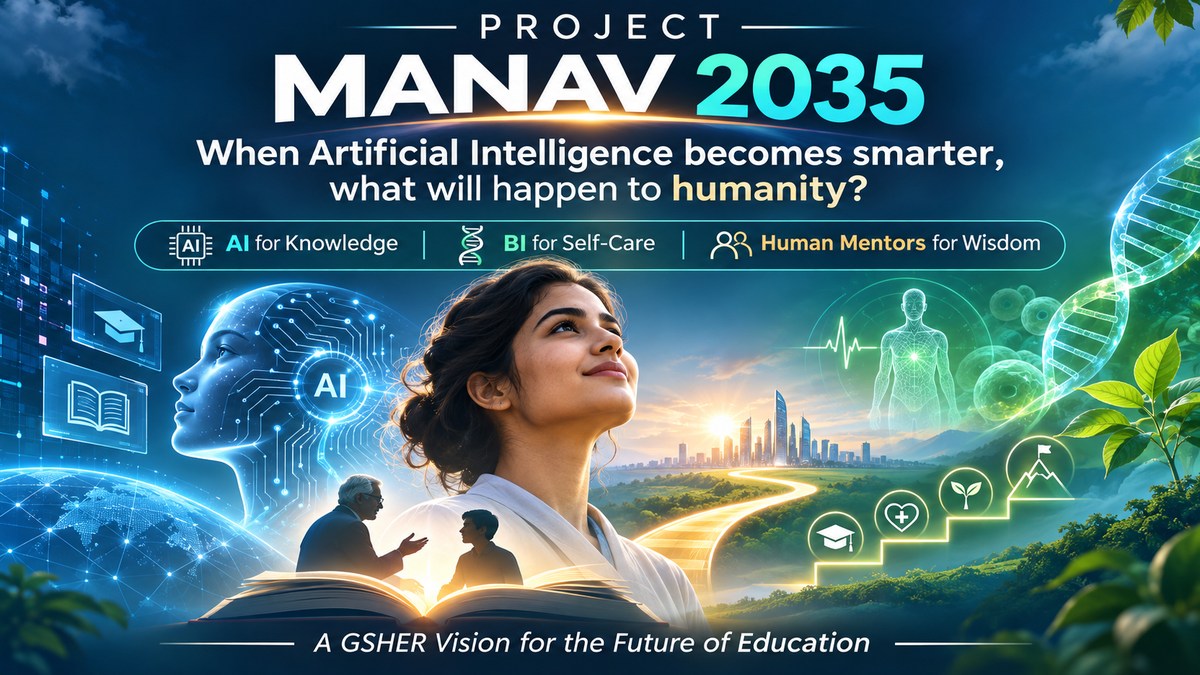
The MANAV framework has three complementary foundations:
AI for Knowledge and Practice. Intelligent tools can personalize learning, provide visual demonstrations, simulate situations and help people practise. They can also make mistakes, create misleading answers and reproduce bias. Verification and qualified human oversight remain essential.
BI for Biological Awareness and Self-Care. People need to understand their body and mind, recognize relevant signals, develop health-supportive routines and know when to seek professional help.
Human Mentors for Wisdom, Character and Purpose. Teachers, parents, clinicians, community leaders and experienced professionals nurture empathy, ethics, courage, critical thinking, resilience and meaningful relationships.
Why Biological Intelligence matters
We teach students about the solar system, algorithms and industrial processes, but often give them little practical education about sleep, stress, recovery, movement, nutrition or the effects of chronic overload. An accomplished professional may understand complicated technology while overlooking persistent exhaustion or the need for medical care.
GSHER proposes Biological Intelligence (BI) as the learnable capacity to notice and interpret relevant internal and contextual signals, regulate immediate reactions, make safe evidence-informed choices, learn from feedback and maintain health-supportive biological rhythms.
This is not a claim that cells consciously reason like humans. It is a practical concept for teaching adaptive self-healthcare competence. A person living with chronic illness can demonstrate excellent BI through informed care, appropriate treatment adherence and timely help-seeking. Health status alone is not a measure of intelligence.
GSHER has also proposed research into a Biological Quotient (BQ) across seven domains: signal awareness; interpretation and calibration; state regulation; vitality stewardship; adaptive learning; rhythm and recovery; and safety and help-seeking.
BQ is a developmental research proposal, not a validated standardized test. It must not be used to diagnose disease or rank children, workers or patients. Research must first establish its reliability, validity, fairness and practical value.
The teacher of 2035 must also be a mentor
AI can provide explanations and formative practice. Human educators remain necessary for good pedagogy, trustworthy assessment, safeguarding, inspiration and personal relationships. Their role can expand toward helping students ask better questions, handle setbacks, reason ethically, manage conflict and discover purpose.
A future classroom should ask not only, “What did you learn?” but also, “What did you question? How did you treat others? What did you learn about yourself?” Learning how to care for one's body and mind should be a fundamental life competence, not an optional chapter.
MANAV beyond the classroom
Education: AI-supported learning paired with mentorship, critical thinking, values and body–mind literacy.
Healthcare: AI-assisted information and clinical workflows combined with informed patients, evidence-based self-care and professional clinical oversight. GSHER's CelluReva™ educational framework—Reset, Revive, Reprogram and Restore—can structure sustainable health-supportive behaviour without promising to cure every disease.
Agriculture: Data-informed farming alongside agricultural expertise, environmental stewardship, farmer health, heat safety and rural resilience.
Business: AI-enabled productivity joined with reskilling, ethical leadership, worker wellbeing and humane transitions.
Governance: Better public information and service delivery with transparency, citizen rights, human accountability and responsible AI.
Family and society: Digital literacy alongside sleep, relationships, parenting, intergenerational understanding, emotional support and community belonging.
Across every sector, the principle remains unchanged: technology should serve human development, not define the value of a human being.
Why Odisha and GSHER?
Odisha's growing AI ecosystem creates an opportunity to explore human-centred applications of technology. OSOU's open and distance learning experience and GSHER's focus on self-healthcare education offer a possible foundation for interdisciplinary programmes, subject to institutional approvals.
Project MANAV could begin with small, evaluated pilots in teacher mentorship, AI literacy, self-healthcare education and community wellbeing. Universities, medical institutions, agricultural experts and technology partners would bring the necessary disciplinary expertise. The proposed BQ programme would remain a separate research effort until it is scientifically validated.
The ambition is not to establish a competing AI laboratory. It is to ensure that technological advancement is accompanied by the human capabilities needed to use it wisely.
The future must remain human
Imagine a student who is academically capable and also understands the importance of sleep and recovery. A doctor supported by AI who continues to listen compassionately. A farmer using data without losing ecological judgment. A business that grows without treating workers as disposable. A family that benefits from digital tools without sacrificing genuine connection.
That would be meaningful progress.
AI for Knowledge. BI for Biological Awareness and Self-Care. Human Mentors for Wisdom, Character and Purpose. GSHER for Health and Human Empowerment.
The great question of the AI century is not whether machines will become more intelligent. It is whether we will use that intelligence to become more fully human.
Project MANAV 2035 is an invitation to build that future.
Self-healthcare is the best healthcare. One Cell • One Earth • One Health.
Explore GSHER · Project RESPECT
Editorial note: Project MANAV is a proposed framework. Biological Quotient (BQ) is not yet a validated measurement instrument. Content is educational and does not replace professional medical advice.
Reader conversation
Comments & replies
Share a thoughtful response. Every comment is reviewed before it is published.
No published comments yet. Start the conversation.