
Original source and attribution
Source: An expanded literary retelling of a Buddhist anecdote narrated by Osho in Vedanta: Seven Steps to Samadhi, Chapter 15. The dialogue and descriptive details have been adapted for storytelling.
The complete story
Not everything that comes to you needs to become a part of you.
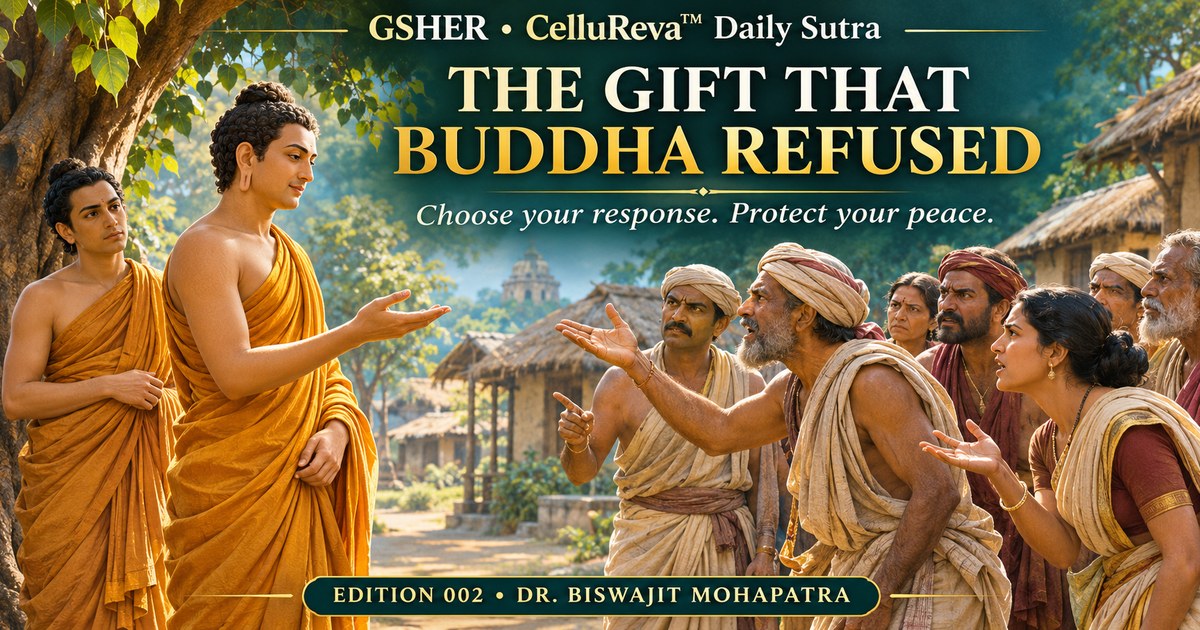
One morning, Gautama Buddha was travelling with his disciples towards a village. Among his disciples was Ananda, his devoted companion.
As they approached the village, they noticed a large gathering of people. But these people had not assembled to welcome Buddha. They were angry with him. His teachings challenged their traditional beliefs, their understanding of religion and their established ways of living.
The moment Buddha entered the village, they surrounded him.
They questioned his wisdom, challenged his teachings and began insulting him. Some accused him of misleading people. Others used offensive language.
Ananda could not bear the humiliation of his master. His muscles tightened, his breathing changed, and anger began rising within him. He wanted to defend Buddha.
But Buddha remained remarkably peaceful.
He neither interrupted them nor attempted to justify himself. He listened patiently until the villagers began to exhaust themselves.
The villagers were puzzled. They had expected an argument, a confrontation or at least some expression of anger.
Instead, they encountered silence and compassion.
Finally, Buddha addressed them.
“Have you finished? I have to reach another village where people are waiting for me. If you have more to say, I shall listen when I return.”
One of the villagers stepped forward.
“We have insulted you. We have questioned your wisdom. We have said terrible things about you. Why are you not angry?”
Buddha looked at him with compassion.
He then told them about an incident in the previous village.
“The people there had brought me sweets as a gift. I did not accept them. Tell me, what would they have done with those sweets?”
The villagers replied that the people would have taken the sweets back and distributed them among themselves.
Buddha smiled.
“You have brought me a different kind of gift today. You have brought anger, hatred and insults. But I have chosen not to accept them. With whom will these gifts remain?”
A silence descended upon the gathering.
The villagers had come to disturb Buddha, but they discovered that their own minds were disturbed.
Buddha was not denying their freedom to speak. He was exercising his freedom to respond.
He continued his journey, leaving behind the insults that had been offered to him.
Ananda walked beside his master, reflecting on what he had witnessed.
He had seen two completely different responses to the same event. While his own body and mind had become agitated, his master had remained peaceful.
The villagers had offered anger to both of them.
One had almost accepted it.
The other had refused.
The event was the same. The internal experience was entirely different.
Deeper philosophical wisdom
Every day, life offers us different kinds of gifts.
Someone criticises us. Someone ignores us. Someone questions our ability. Someone disappoints us. Someone behaves in a manner that we consider unacceptable.
Without realising it, we accept these events as instructions for our internal state.
A colleague becomes angry, and we become angry.
A stranger behaves impatiently, and we lose our peace.
Someone sends an unpleasant message in the morning, and we carry its emotional consequences throughout the day.
The person who disturbed us may have forgotten the incident within minutes, while we continue to experience it for hours, days or even years.
Have we unknowingly handed over the regulation of our internal environment to the external world?
Buddha's wisdom was not about suppressing anger. Nor was it about becoming indifferent to injustice.
It was about developing the freedom to choose a response.
There is a profound difference between experiencing an emotion and allowing that emotion to dictate our behaviour.
The CelluReva interpretation
Imagine two individuals receiving the same unpleasant message.
One becomes furious. His heart rate increases, his muscles tighten, and he repeatedly thinks about the incident.
The other experiences the initial discomfort but chooses to examine the situation before responding.
Their external circumstances are identical, but their physiological experiences may be significantly different.
This brings us to an important CelluReva principle:
E + R = O
- E — Event: What happens around us.
- R — Response: How we respond to it.
- O — Outcome: What follows the interaction.
We cannot always change the event, but we can learn to influence our response and thereby influence the outcome.
The formula is a conceptual model for conscious living, not a mathematical law.
Much of our energy is spent trying to change external circumstances. CelluReva invites us to invest some of that energy in understanding and transforming our own responses.
This is the essence of Conscious Participation in biological functioning.
E + R = O — The power of response
Event
What happens around us
Response
How we respond
Outcome
What follows the interaction
A conceptual model for conscious living, not a mathematical law or a guarantee that we can control every outcome.
Modern scientific explanation
When we perceive an event as threatening, humiliating or personally significant, interconnected neural circuits participate in evaluating the situation and preparing the body to respond.
The amygdala participates in evaluating emotionally significant stimuli. The hypothalamus coordinates aspects of the autonomic and endocrine stress response.
Depending on the circumstances, the sympathetic nervous system and hypothalamic–pituitary–adrenal (HPA) axis may become activated.
This can result in increased heart rate, changes in blood pressure, muscle tension, increased glucose availability and the release of stress-related hormones.
These responses are not inherently harmful. They are essential biological adaptations for survival.
However, repeated or prolonged activation, particularly without adequate recovery, can contribute to cumulative physiological burden, known as allostatic load.
Prefrontal and other cortical networks participate in emotional regulation, contextual assessment, impulse control and cognitive reappraisal.
Through repeated practice, we can develop healthier patterns of emotional regulation.
Buddha's story provides a philosophical illustration of this capacity. Modern neuroscience helps us understand some of its possible biological foundations.
Biochemistry can be influenced by biography — including how we repeatedly experience and respond to life.
The Biology of Conscious Response
- Automatic reaction
- Stress activation
- Possible prolonged distress
- Conscious regulation
- Constructive action
- Possible adaptive outcome
Conceptual illustration of interacting psychological and physiological processes, not two anatomically independent neural pathways. Outcomes depend on context, safety, support and practice.
Scientific references
- McEwen BS. Protective and damaging effects of stress mediators. New England Journal of Medicine. 1998;338:171–179. DOI · PubMed
- Ochsner KN, Gross JJ. The cognitive control of emotion. Trends in Cognitive Sciences. 2005;9:242–249. DOI · Full text
- Gross JJ. Emotion regulation: Current status and future prospects. Psychological Inquiry. 2015;26:1–26. DOI
Relevant CelluReva pillars
- Mitochondrial priming
- Hormonal architecture
- Cellular repair
- Epigenetic expression
- Neuro-inflammatory balance
- Coherent recovery
- Mitochondrial Priming — Understanding the metabolic demands of stress and recovery.
- Hormonal Architecture — Recognising the role of stress-related endocrine responses.
- Cellular Repair — Supporting recovery through appropriate rest and healthy routines.
- Epigenetic Expression — Understanding how sustained environmental exposures may influence gene regulation.
- Neuro-inflammatory Balance — Recognising interactions between chronic stress, neural regulation and inflammatory processes.
- Coherent Recovery — Integrating emotional awareness, sleep, relaxation and physiological recovery.
Emotional regulation is one component of self-healthcare. It cannot independently guarantee cellular repair, disease remission or protection from illness.
Apply the Four Rs
Reset
RESET — Interrupt the automatic reaction
Recognise anger as it arises. Observe your breathing, muscular tension and emotional state before acting.
Revive
REVIVE — Recover physiological balance
Breathe comfortably, release unnecessary muscular tension and give yourself an opportunity to recover.
Reprogram
REPROGRAM — Develop a different response
Examine your interpretation of the event. Practise responding consciously rather than repeating habitual emotional patterns.
Restore
RESTORE — Protect your internal environment
Avoid unnecessarily prolonging an emotional disturbance through resentment, rumination or repeated mental confrontation.
Your daily practical experiment
The art of refusing an unwanted emotional gift
Whenever someone criticises, insults or irritates you today, practise the following exercise:
- Recognise the event without immediately responding.
- Observe your bodily sensations and emotional state.
- Take three comfortable, unforced breaths.
- Ask yourself whether your habitual reaction will improve the situation.
- Choose a constructive response, establish a boundary or disengage safely.
Remember that choosing peace does not mean tolerating abuse, remaining silent against injustice or abandoning your responsibilities.
Sometimes the most conscious response is a firm refusal.
A question for self-reflection
Before going to sleep tonight, ask yourself:
How many people were able to disturb my internal environment today, and how long did I allow their actions to remain within me?
Could I have responded differently?
Sutra of the day
You cannot always choose what the world offers you. But you can learn to choose what you carry within you.
Do not allow another person's momentary anger to become your prolonged biological burden.
Dr. Biswajit Mohapatra Founder & Chairman, GSHER CelluReva™ Protocol
Ancient Wisdom • Modern Science • Conscious Living
Self-Healthcare Is the Best Healthcare.
One Cell • One Earth • One Health.
Educational disclaimer: This article is intended for philosophical reflection and self-healthcare education. It does not replace professional medical or psychological care.
Traditional philosophy and stories are presented for reflection. Scientific explanations should distinguish evidence from interpretation. These educational editions support professional healthcare.